


Trade between China and Vietnam has become one of the busiest cross-border corridors in Asia, and the counterfeit trade has grown with it. Goods from southern China reach Vietnamese markets within days through the northern land crossings, then flow into retail, e-commerce, and transit routes to Cambodia. For brand owners the difficulty has always been visibility: everyone knows the trade exists, but few can say where it moves, in what volumes, and through which gates.
A largely overlooked public source now answers those questions. Between January 2025 and July 2026, Nanning Customs, which supervises the Chinese ports along this border, published 486 penalty decisions covering counterfeit goods stopped on their way out of China.[1] These decisions record 799,222 seized units across 1,410 item lines and 312 distinct brands. Customs assessed the goods at RMB 10.8 million (about USD 1.6 million) and imposed RMB 1.4 million (about USD 210,000) in fines. Every decision names the port, the goods, the brand, and the exporter, so read together they form a route map of the counterfeit trade heading south.
Dataset at a glance
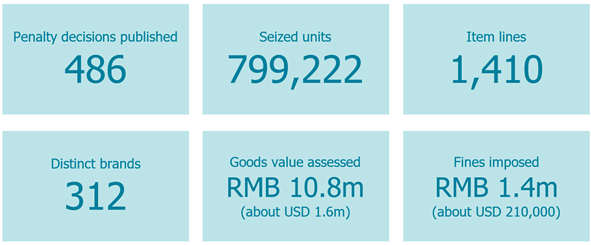
Period: January 2025 – July 2026. Source: penalty decisions published by Nanning Customs. USD at RMB 6.67 per USD.
The route map
Five land crossings carry most of the traffic, and two dominate. Youyi Guan, the Friendship Pass, faces Huu Nghi in Lang Son and recorded 184 cases, or 38 per cent of the total. Aidian, facing Chi Ma in Lang Son, recorded 98 cases and the largest volume at over 352,000 units. Together the two Lang Son crossings account for 58 per cent of all cases. Dongxing, facing Mong Cai in Quang Ninh, recorded 81 cases but the highest goods value at RMB 3.2 million (about USD 480,000), while Shuikou and Longbang in Cao Bang add 103 more.
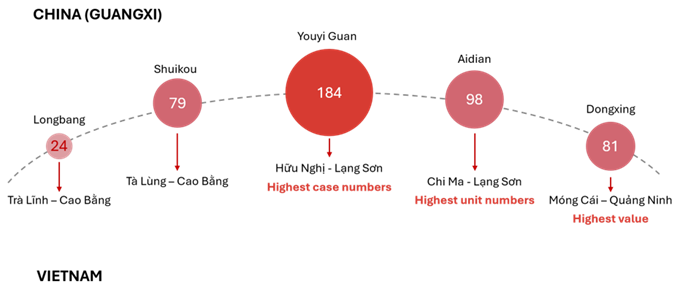
Figure 1: The five land crossings, sized by seizure cases. Schematic, not to scale. Source: penalty decisions published by Nanning Customs
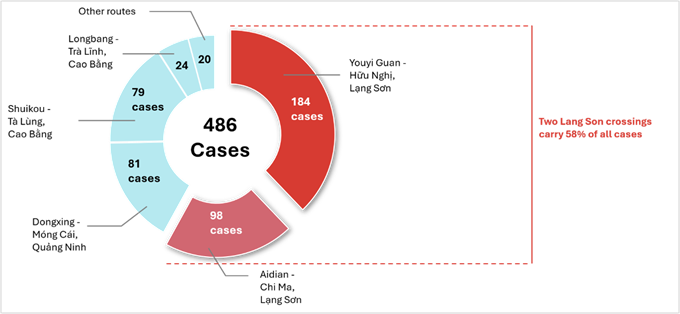
Figure 2: Pie chart of the five land crossings, sized by seizure cases . Source: penalty decisions published by Nanning Customs
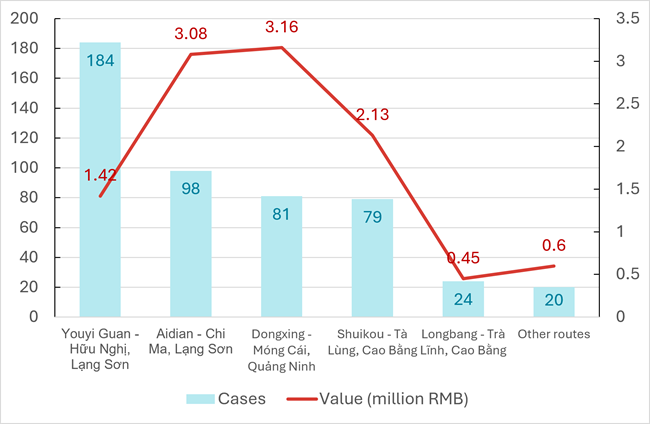
Figure 3. Seizure cases and values by border crossing, showing the Chinese port and its Vietnamese counterpart. Source: 486 published Nanning Customs penalty decisions, January 2025 to July 2026.
|
Chinese port |
Vietnamese counterpart |
Cases |
Units |
Value (RMB / USD) |
|
Youyi Guan |
Hữu Nghị · Lạng Sơn |
184 |
120,207 |
1.42m / 213k |
|
Aidian |
Chi Ma · Lạng Sơn |
98 |
352,208 |
3.08m / 462k |
|
Dongxing |
Móng Cái · Quảng Ninh |
81 |
66,986 |
3.16m / 474k |
|
Shuikou |
Tà Lùng · Cao Bằng |
79 |
164,145 |
2.13m / 319k |
|
Longbang |
Trà Lĩnh · Cao Bằng |
24 |
43,291 |
0.45m / 68k |
|
Other routes |
– |
20 |
52,385 |
0.60m / 90k |
Table 2. Seizures by crossing. Source: penalty decisions published by Nanning Customs.
The trade mode matters as much as the route. Most stopped consignments moved under border trade rules, which allow simplified formality for small cross-border transactions, and counterfeiters exploit that simplicity. One seizure of 180 counterfeit memory modules at Shuikou in February 2025 shows the pattern: a local trading company as exporter, a local logistics provider, and border trade formality throughout.
Product Category
Footwear tops the category table with 338 cases and 124,000 units, followed by apparel at 263 cases and bags and leather at 253. Electronics recorded 118 cases but nearly 168,000 units, and cosmetics reached 207,000 units across just 68 cases, which points to bulk consignments. Small frequent shipments and bulk cargo run side by side. Bearings account for 88 cases, auto parts and tools for 59 more, so this is far from a luxury-goods story: it touches electronics, personal care, and safety-critical industrial parts.
Footwear leads on cases; cosmetics and electronics lead on volume
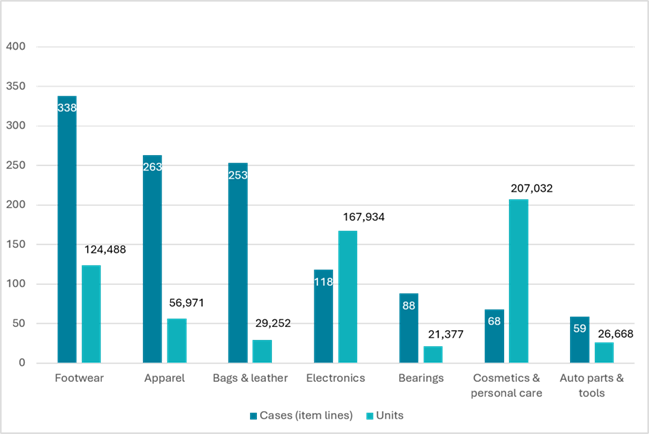
Figure 4. Cases against units seized by product category. High-frequency small consignments (footwear, apparel) run alongside bulk shipments (cosmetics, electronics). Source: penalty decisions published by Nanning Customs.
Each gate also has a product profile of its own, so a brand can match its category to the two or three gates that matter most.
Each gate has a product profile (item lines per category)
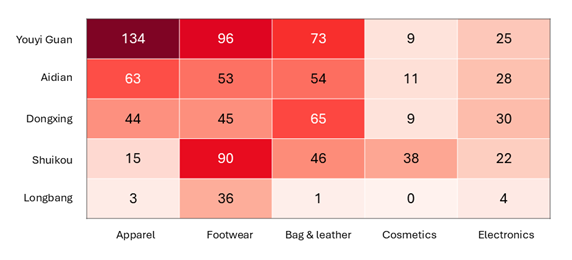
Figure 5. Item lines by gate and category. Youyi Guan leads on apparel, Dongxing on bags, Shuikou on footwear and cosmetics, and Longbang is almost entirely footwear. Source: penalty decisions published by Nanning Customs.
The brand spread tells a similar story. The most-seized names are the global fashion and sportswear marks anyone would predict. The more useful signal sits below them: mid-tier consumer labels, technology brands, component makers and personal care houses, many of which may not know their goods cross this border at all. One consignment held thousands of branded jewellery boxes, pouches and authentication cards with almost no finished jewellery, and packaging travelling separately points to assembly or repackaging in Vietnam.[2]
The decisions name the Chinese exporters, but those names lead nowhere. Most are paper companies created under the export agency system, and the true consignors hide behind them. Vietnamese importers are not named at all. The enforcement value of the documents therefore lies not in the parties but in the pattern: which goods, which crossings, which volumes, and how often.
What the pattern reveals on closer reading
Enforcement intensified sharply through 2025: monthly cases roughly doubled from the first half of the year to a peak of 46 in September, and stayed high through December.
Enforcement intensified through 2025, peaking in September
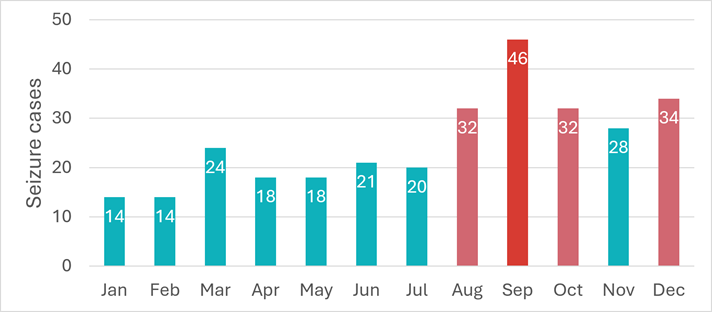
Figure 6. Seizure cases by month, 2025. Source: penalty decisions published by Nanning Customs.
Beneath the trend, four structural findings stand out.
|
Finding |
Figure |
What it suggests |
|
Multi-brand cases |
43% of cases; up to 34 brands in one shipment |
Consolidators pack many marks per truck; cost-shared programmes fit |
|
Single-use exporters |
163 of 237 named companies appear once |
Paper companies under the export agency system |
Table 3. Structural findings from the 486 decisions. Source: penalty decisions published by Nanning Customs.
What rights holders should do with this
For goods entering by land from China, the answer to "where should we stand guard" is a short list of named crossings in Lang Son, Quang Ninh and Cao Bang. Vietnam customs recordal is a natural starting point, though a modest one. A recordal puts the mark, the genuine product features, and the rights holder’s contacts in front of Vietnam customs nationwide. Officers who detect suspect goods can then notify the rights holder, who can confirm and request detention. The recordal runs for two years, renews, and costs little to file.[3]
It is fair to say what recordal cannot do. Actual detentions capture only a fraction of the likely flow. Customs officers carry heavy daily workloads across revenue and clearance duties, and IP enforcement is a small part of their remit. When goods are detained, the rights holder must respond within a short statutory window and lodge security, which requires someone local with authentication support ready. And recordal covers import and export, so transit goods and domestic assembly need other tools. It is the base layer of a border programme, not the programme itself.
The timing favours action. The United States designated Vietnam a Priority Foreign Country in the 2026 Special 301 review, and a Section 301 investigation is running.[4] Vietnamese enforcement has responded visibly. Within one month of a national campaign launched in May 2026, police opened 90 criminal cases against 142 defendants for IP crimes, and over 1,000 infringing websites were blocked.[5]
The data supports moves beyond recordal. Matching the seizure pattern against distributor arrangements can expose grey channels as well as counterfeits, and the category and port data let market sweeps in Hanoi and Ho Chi Minh City begin from known routes rather than guesswork. A sensible first step is simply to check whether a Vietnam customs recordal exists, covers the right marks, and names someone who answers the phone, and then to build outward from there.
[1] Penalty decisions (行政处罚决定书, administrative penalty decisions) published by Nanning Customs and its subordinate offices (Youyi Guan, Aidian, Dongxing, Shuikou, Longbang, Wuzhou, Nanning Postal, Nanning Wuxu Airport and Pingxiang Customs) on the China Customs administrative penalty disclosure platform, http://www.customs.gov.cn, January 2025 to July 2026.
[2] Aidian Customs penalty decision, 2025, recording a mixed consignment of branded jewellery packaging, pouches and authentication cards (dataset case record).
[3] Law on Customs 2014 (Law No. 54/2014/QH13), articles 73-76, and implementing procedures under Circular 13/2015/TT-BTC as amended by Circular 13/2020/TT-BTC: applications are filed with the customs authority, effective for two years and renewable, https://www.customs.gov.vn.
[4] Office of the United States Trade Representative, 2026 Special 301 Report (April 2026), designating Vietnam a Priority Foreign Country, https://ustr.gov/issue-areas/intellectual-property/special-301; Section 301 investigation of Vietnam’s IP practices, docket USTR-2026-0364, https://www.regulations.gov.
[5] Thuế & Hải quan Online (Tax & Customs Online, Ministry of Finance), "1 tháng, Công an khởi tố 142 đối tượng vi phạm về sở hữu trí tuệ" (In one month, police prosecute 142 defendants for IP violations), 24 June 2026, reporting the campaign under Official Telegram No. 38/CĐ-TTg of the Prime Minister, https://thuehaiquan.tapchikinhtetaichinh.vn/1-thang-cong-an-khoi-to-142-doi-tuong-vi-pham-ve-so-huu-tri-tue-159860.html; and "Bảo vệ thương hiệu Việt trước làn sóng giả mạo trực tuyến" (Protecting Vietnamese brands against the wave of online counterfeiting), 19 June 2026, reporting over 1,000 websites blocked, https://thuehaiquan.tapchikinhtetaichinh.vn/bao-ve-thuong-hieu-viet-truoc-lan-song-gia-mao-truc-tuyen-159388.html.
Co-authors: Khanh Nguyen, Quynh Ngo, Zoe Liu, and Sigrid Sun
Visuals and charts: Tyler Do


