

Thailand's Department of Intellectual Property (DIP) has published IP filings statistics for the first half of 2026 (January – June 2026) https://www.facebook.com/share/p/195YtEgr3K/. In this second article of our two-part series, we examine the latest trends in invention patents, petty patents and design patents. Beyond the headline figures, the data provides useful insights into the balance between domestic and foreign innovation, the sectors driving new filings, and possible improvements in examination efficiency within the Thai patent system.
Key Highlights
Patents
While filing activity has modestly increased by under 5% year-on-year, patent grants significantly increased by 20% year-on-year.
|
Metric |
Value |
Change vs. Same Period Previous Year |
|
Patent Applications Filed |
4,299 |
+4.47% |
|
Patents Granted (Registrations) |
2,887 |
+20.49% |
|
Patent Grants as % of Applications* |
~ |
67.2% |
Applicant Origin
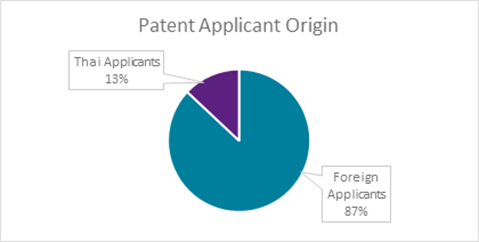
Foreign applicants dominate Thailand's invention patent filings, accounting for 87% of all applications.
Top 5 Patent Applications
|
Rank |
Applicant |
Country |
Applications |
|
1 |
Toyota Motor Corporation |
Japan |
139 |
|
2 |
Qualcomm Incorporated |
United States |
136 |
|
3 |
Nippon Steel Corporation |
Japan |
78 |
|
4 |
JFE Steel Corporation |
Japan |
63 |
|
5 |
Syngenta Crop Protection AG |
Switzerland |
56 |
Japanese applicants remain strongly represented, holding three of the top five positions. The applications represent automotive, communications technology, steel manufacturing, and agricultural technologies, with Toyota (automotive) and Qualcomm (communications technology) nearly tied for first place.
Top 5 Innovation Sectors
The technology fields receiving the highest number of patent applications.
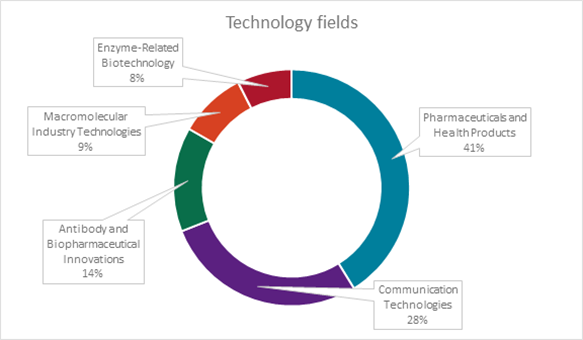
Pharmaceuticals and Healthcare-related innovations (562 applications) lead the number of applications filed, reflecting ongoing R&D activity in medicines, medical treatments, and health technologies. This is followed by Communications Technology (380 applications). The combined presence of Antibody and biopharmaceutical innovations at number 3 (195 applications) and Enzyme-related biotechnology at number 5 (102 applications) demonstrates strong activity in advanced life sciences and biotechnology. Macromolecular industry technologies at number 4 (126 applications) suggests significant innovation in polymers, industrial chemistry, and advanced materials.
Conclusion – Patents
The first-half 2026 statistics indicate that Thailand continues to attract substantial international patent activity while also showing encouraging improvements in examination output. The strong growth in granted patents, combined with sustained filing activity in pharmaceuticals, communications and biotechnology, reinforces Thailand's position as an important patent jurisdiction within Southeast Asia.
Petty Patent
While invention patents are largely driven by multinational companies, the petty patent system presents a very different picture, with innovation being overwhelmingly domestic.
Petty patent filings increased by about 13%, indicating strong growth in grassroots and incremental innovation, while registrations increased substantially by about 45%, suggesting improved examination practices.
|
Metric |
Value |
Change vs. Same Period Previous Year |
|
Petty Patent Applications Filed |
2,641 |
+13.10% |
|
Petty Patents Registered |
1,345 |
+45.41% |
Applicant Origin
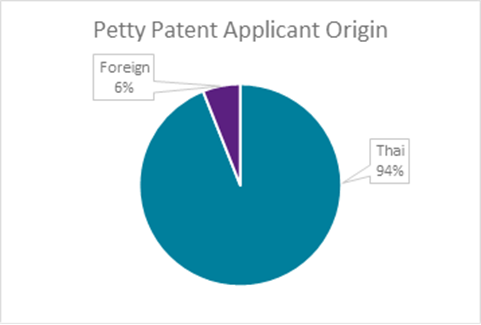
Thai applicants overwhelmingly dominate the system, accounting for 94% of filings.
Applicant Origin
|
Rank |
Applicant |
Country |
Applications |
|
1 |
Rajamangala University of Technology Rattanakosin |
Thailand |
96 |
|
2 |
Burapha University |
Thailand |
71 |
|
3 |
Srinakharinwirot University |
Thailand |
64 |
|
4 |
Kasetsart University |
Thailand |
60 |
|
5 |
Khon Kaen University |
Thailand |
58 |
Top 5 Innovation Sectors
The innovation categories with the largest number of applications.
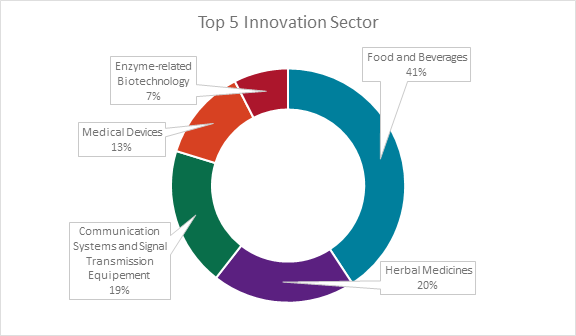
Food and beverage sector (282 applications) is the largest source of petty patent filings. This reflects Thailand's strong agricultural and food-processing industries. Herbal medicine (137 applications), Medical devices (88 applications) and Enzyme-Related Biotechnology (52 applications) in the top-5 innovation sector applications indicate commercial and research interests in traditional medicine, healthcare, life sciences and biotech industries. Communications Technology (133 applications) indicate ongoing innovations and interests in electronics and telecommunications in Thailand.
Comparative Insights
Compared with other intellectual property rights reported by the DIP for the same period, petty patents is the most domestically driven form of IP protection among the categories reported, except for copyright, where protection is automatically provided and recordation is optional (99% of applications domestic).
|
IP Right |
Domestic Applicant Share |
|
Patents |
13% |
|
Design Patents |
60% |
|
Trade marks |
56% |
|
Petty Patents |
94% |
Conclusion – Petty Patents
The overwhelming Thai participation rate suggests that the petty patent system serves as an important tool for protecting locally developed practical innovations. Unlike invention patents, which are dominated by multinational corporations, petty patent filings are led by Thai universities, indicating a strong role for academic research and technology transfer. Thailand recorded 2,641 petty patent applications during the first six months of 2026, representing 13.10% growth over the same period of the previous year. The most active innovation sectors were food and beverages, herbal medicines, communications technology, medical devices, and biotechnology. Thai applicants dominated the system with 94% of all filings, and the leading applicants were major Thai universities. Registrations reached 1,345 granted petty patents, an impressive 45.41% increase, reflecting strong expansion in both innovation activity and IP protection outcomes.
Design Patent
Design patents occupy a middle ground, with both Thai and foreign applicants actively seeking protection for product appearance and industrial designs.
Design patent applications have increased by close to 6% compared with the same period in the previous year, while the number of design patent registrations experience very strong grown of 45% compared with the same period in the previous year.
|
Metric |
Value |
Change vs. Same Period Previous Year |
|
Design Patent Applications Filed |
3,179 |
+5.79% |
|
Design Patents Registered |
3,630 |
+45.03% |
Applicant Origin
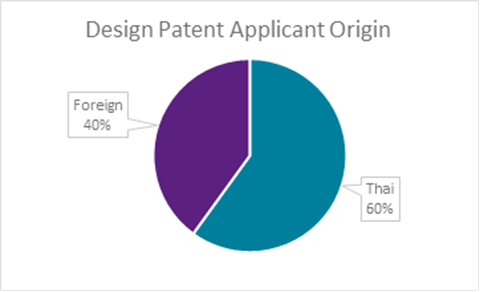
Thai applicants account for a majority of design filings (60%). Foreign applicants (40%) still represent a substantial portion of applications, demonstrating international interest in design protection within Thailand.
Top 5 Design Patent Applicants
Top 5 design patent applicants are listed below:
|
Rank |
Applicant |
Country |
Applications |
|
1 |
Suan Sunandha Rajabhat University |
Thailand |
114 |
|
2 |
Burapha University |
Thailand |
65 |
|
3 |
Thammasat University |
Thailand |
59 |
|
4 |
Rajamangala University of Technology Rattanakosin |
Thailand |
58 |
|
5 |
Beiersdorf AG, Hamburg (Nivea Group) |
Germany |
53 |
Four of the five leading applicants are Thai universities, reflects how academic institutions are playing a significant role in industrial design creation and protection. Compared with the top 5 product design categories that include textile patterns, fabric designs and jewelry, this strongly suggest interests in protection of traditional Thai or locally inspired Thai designs and jewelry. The only foreign organization appearing in the Top 5 is Beiersdorf AG (Germany), a multinational consumer products company.
Top 5 Design Categories
Textile and Fabric Designs (424 filings) is the most active category, with Jewelry (255 filings) coming in fourth, both reflecting the importance of local fashion, apparel, and traditional textile-related industries. Packaging designs (283 filings) highlights the increasing commercial value of product presentation and branding. Automobiles and related equipment (279 filings) indicate ongoing interest in Thailand as a automobile manufacturing hub. The presence of Construction Equipment in the top five demonstrates demand for protecting industrial product designs.
Conclusion – Design Patent
Thailand recorded 3,179 design patent applications during the first six months of 2026, representing 5.79% growth compared with the previous year. The most active design sectors were textile patterns, packaging, automotive products, jewelry, and construction equipment. Thai applicants accounted for 60% of filings, and four of the five largest applicants were Thai universities. Meanwhile, design patent registrations reached 3,630, an impressive 45.03% increase year-on-year, indicating strong growth in the protection and commercialization of industrial designs in Thailand.
Concluding Remarks
The first-half 2026 statistics highlight three distinct innovation trends in Thailand. Invention patents continue to be driven primarily by international companies seeking protection for advanced technologies, while petty patents remain an important mechanism for protecting practical innovations developed by Thai universities and local businesses. Meanwhile, continued growth in design patent filings reflects increasing recognition of the commercial value of product appearance and branding. Together, these trends suggest a maturing IP ecosystem that supports both international investment and domestic innovation, making Thailand an increasingly important jurisdiction for businesses seeking comprehensive IP protection in Southeast Asia.
Authors: Thitiya Lueabrassamee (patents and petty patents), Pongsathorn Srikornvit (design patents).

